Paraprofessionals Don’t Have Just One Job. Why Are We Training Them That Way?
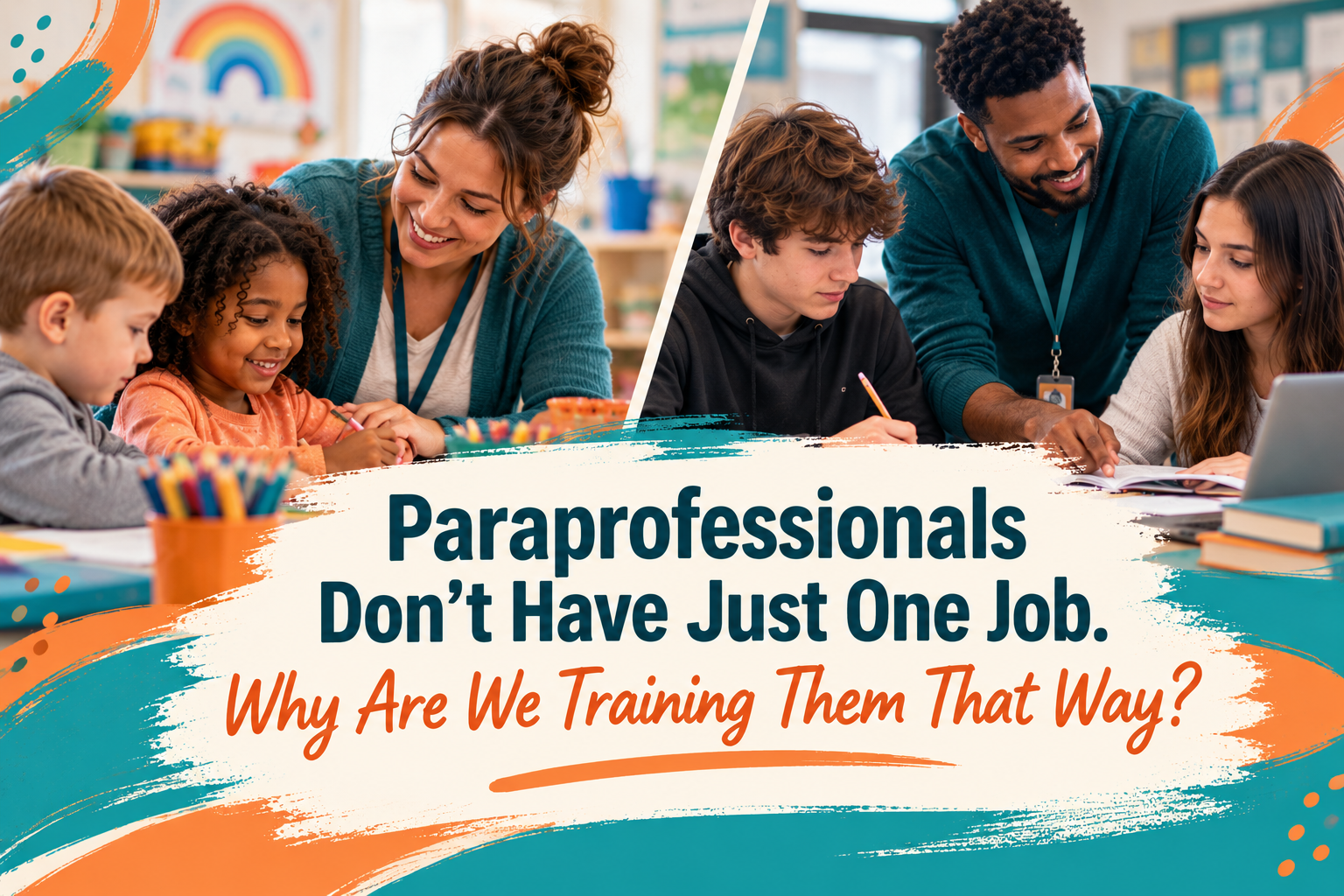
Two paraprofessionals supporting students of different ages in classroom settings, highlighting the many roles paraprofessionals fill throughout the school day.
A paraprofessional’s day can change in an instant.
One moment, they may be helping a student transition into the classroom. The next, they’re reinforcing a literacy skill, supporting a small group, helping a multilingual learner, responding to a behavioral challenge, or helping a student organize an assignment.
And somewhere in there, someone has probably asked, “Where’s my pencil?”
That’s the reality of the paraprofessional role. The job isn’t one thing. So professional learning shouldn’t prepare them for just one thing.
The School Day Doesn’t Come in Compartments
We often approach paraprofessional professional learning one topic at a time: behavior, literacy, classroom management, special education, executive functioning.
Those are all important. But that isn’t how a paraprofessional experiences the school day.
A student struggling with a reading assignment may also be struggling with attention or organization. Frustration with an academic task may quickly become a behavioral challenge. A multilingual learner may need both academic and language support.
The skills overlap because the needs of students overlap.
If we expect paraprofessionals to support the whole student, shouldn't we prepare them for the whole experience?
Preparing for the Whole Experience
That idea is at the heart of the Elevate Educators Paraprofessional Professional Learning System.
We didn't want to create another collection of disconnected courses. We wanted professional learning that reflects what paraprofessionals actually encounter throughout a school day.
That means building knowledge across behavior and classroom management, academic support, literacy, mathematics, small group instruction, executive functioning, multilingual learners, communication, inclusive practices, and more.
Not because every paraprofessional needs to become an expert in everything.
Because on any given day, they may need a little bit of all of it.
I see that desire to be prepared firsthand in the paraprofessional courses I teach at Bergen Community College. My classes have consistently included at least 25 participants who meet for three hours a week, for 12 consecutive weeks, beginning at 6:30 in the evening.
After a full day of work and life, showing up for three hours of learning says something.
Paraprofessionals want to be prepared for the work we're asking them to do.
More Than Training for the First Day
Preparing paraprofessionals shouldn't end with orientation or a workshop on one particular challenge.
A new paraprofessional needs a strong foundation. An experienced paraprofessional may need to deepen skills based on the students they are supporting right now.
That's why Elevate Educators is designed as a comprehensive, self-paced professional learning system that can grow with them.
Because the goal isn't simply to prepare a paraprofessional for their first day.
It's to prepare them for the whole experience.
If your district is thinking about how it prepares paraprofessionals, our Paraprofessional Learning System can help you take a closer look at your current approach and identify opportunities to build a more comprehensive model.